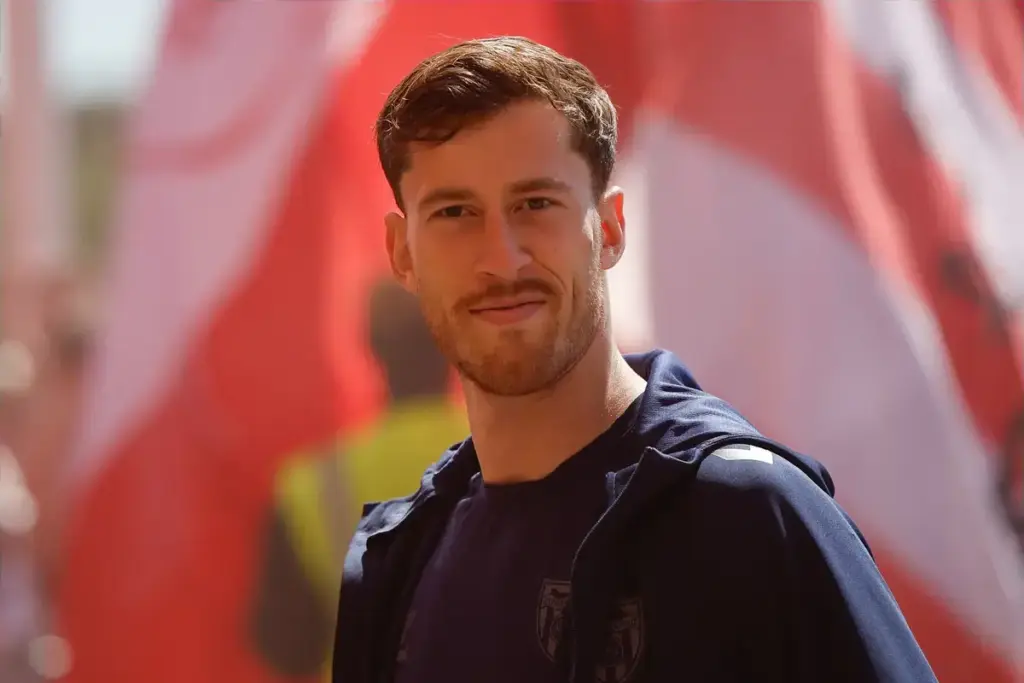

Robin Roefs has just made the kind of decision that tends to go unnoticed outside Wearside but matters enormously inside it.
By committing his long-term future to Sunderland, the goalkeeper has quietly closed the book on any lingering speculation about his next move. For a club still building its Premier League identity under Régis Le Bris, that is no small thing.
New contracts rarely generate headlines the way transfers do, yet this one deserves attention. Roefs was signed as a promising young number one with potential.
He is now behaving like a player who sees his long-term future at the Stadium of Light, and that shift in mindset says as much about the club’s trajectory as it does about him.
Why Robin Roefs’ New Contract Signals a Major Statement for Sunderland
Sunderland’s rebuild has been defined by patient recruitment rather than marquee spending, and Roefs’ decision to extend fits that pattern perfectly.
Rather than treating his early impact as a stepping stone to a bigger move, he has chosen to grow with the project Le Bris is building.
That matters for a squad led by Granit Xhaka. A captain of Xhaka’s experience sets a tone in the dressing room, and a goalkeeper willing to commit long-term alongside him sends a message to the rest of the squad about the direction the club is heading. Stability between the posts is not glamorous, but it is foundational.
Sunderland’s hierarchy will also see this as validation of their recruitment model.
Identifying a goalkeeper early, developing him under a settled coaching structure, and then tying him down before his value spirals further is precisely the template smaller-spending Premier League clubs need to follow if they want to compete sustainably.
Assessing the True Market Value of Sunderland’s £9m Goalkeeper
Sunderland signed Roefs for an initial £9m, with a further £2.5m available in add-ons.
At the time, it looked like a sensible piece of business for a goalkeeper with obvious upside.
With the benefit of hindsight, it now looks like one of the shrewdest deals struck by any Premier League club in recent memory.
Context makes the point clearly. According to reports, Coventry City paid around £30m, including add-ons, to sign Carl Rushworth, while Newcastle United reportedly spent £25.7m on Lukas Hornicek.
Neither deal has been confirmed with the same level of transparency as Sunderland’s, but the figures being reported illustrate just how competitive the goalkeeper market has become.
Placed alongside those reported fees, Sunderland’s £9m outlay for Roefs looks like a bargain rather than a gamble.
Chronicle Live’s analysis of Sunderland’s transfer dealings highlights exactly this gap between fee and output, and it is difficult to argue with the underlying logic. Few clubs have found value in this position quite as efficiently.
The wider goalkeeper market has been inflated by scarcity as much as talent.
Clubs are increasingly willing to pay a premium for young, technically capable shot-stoppers who can also play out from the back.
Sunderland effectively got ahead of that curve, and Roefs’ new deal now protects the asset they built at a fraction of the going rate.
Analyzing the Numbers Behind Roefs’ Rise Under Regis Le Bris
Statistics back up the eye test. According to FBref, as cited by Chronicle Live, Roefs recorded a save percentage of 70.1 per cent last season, tying for the fourth-highest figure among goalkeepers in the Premier League.
That is an emphatic number for a young goalkeeper still adjusting to the demands of English top-flight football.
Le Bris deserves credit here too. Sunderland’s defensive structure under the Frenchman has been organised without being overly cautious, giving Roefs a platform to demonstrate both his shot-stopping and his composure on the ball.
A goalkeeper’s numbers are rarely built in isolation, and the coaching setup around him has clearly played its part.
Roefs’ importance to that structure was obvious during their Europa League victory over AZ Alkmaar.
Sunderland won the tie 1-0, a result built on defensive discipline as much as attacking quality. Enzo Le Fée’s decisive European goal settled matters at the other end, but a clean sheet in continental competition against organised opposition is never the product of the outfield players alone.
Nights like that reinforce why the club moved so decisively to tie Roefs down.
European football brings different pressures and unfamiliar opponents, and a goalkeeper capable of delivering under those conditions is worth protecting contractually as well as tactically.
What Roefs’ Long-Term Commitment Means for Sunderland’s Ambitions
Zoom out, and this contract extension fits a broader pattern at Sunderland. Le Bris has built a squad around competitive spirit and tactical clarity rather than reputation, and Roefs’ willingness to stay reinforces that identity.
Players who buy into a project early tend to be the ones who help define it later.
For Xhaka, leading a group that includes a goalkeeper of Roefs’ calibre and mentality makes his job easier. Captains thrive when the players behind them are calm under pressure, and Roefs has shown exactly that temperament since arriving on Wearside.
There is also a financial dimension worth acknowledging.
Every season Roefs continues to perform at this level, his valuation will climb well beyond the £11.5m Sunderland could ultimately pay across the fee and add-ons.
Securing him now, on their own terms, protects both the club’s finances and its long-term goalkeeping plans.
Sunderland fans have watched plenty of promising young players leave before their potential was fully realised. Roefs’ new contract suggests this story could be different.
The bigger question now is how far this goalkeeper, and the team built around him, can go under Le Bris.





Comments.
Loading comments…